🛡️ Built by Matej Vrzala & Martin Vlach • Advancing software security pro-bono & professionally

Budget-driven code security.
Set your price in PR/MR. We optimize the audit.

We improve software security pro-bono for open-source ecosystems, and professionally for engineering teams. Comment @budgetscan $0.50 --max-delay 5m on a PR/MR: BudgetScan plans how deep to scan so it fits your cap and deadline, then deducts only what the scan actually cost.

Early access, still in development. The open-source scanner (nano-analyzer) works today from the command line, and you can call it from your own CI (see the how-to). A GitLab merge-request job, a GitHub Action, and the budget/deadline governor are in private testing and shared during early access. Prepaid credit packs cannot be purchased yet, and all pricing numbers are illustrative. Questions or want early access? Email us.

Cost Estimation & Budget Control

Know what a scan will cost before running it, and enforce hard spending and deadline caps in CI.

Step 1 • Pre-Scan Estimation $0.00 Cost

Model Cost Before Spending a Cent

budget.py discovers scannable source files, filters out tests and vendor trees, and estimates token costs for the selected model and triage rounds before calling any LLM:

# Estimate scannable files & projected token cost:
python3 scan.py /path/to/repo --estimate
Step 2 • Enforced Runtime Caps Hard Ceiling

Hard Budget & Deadline Governor

In our early-access build, the budget governor limits spend and wall-clock execution. If time is running out, it stops scheduling new work and writes a partial report without blocking CI:

# Cap spend to $5.00 and execution to 5 minutes:
python3 scan.py /path/to/repo \
  --budget-usd 5.00 --deadline 5m --triage-rounds 3
Step 3 • PR Bot Trigger Early Access

Trigger from Merge Request Comments

Engineers and reviewers control audit depth and deadline directly from the discussion thread, deducting only actual cost from the team credit pool:

# Comment in GitLab MR or GitHub PR:
@budgetscan $0.50 --max-delay 5m

Internal Workflow & Open-Source Lineage

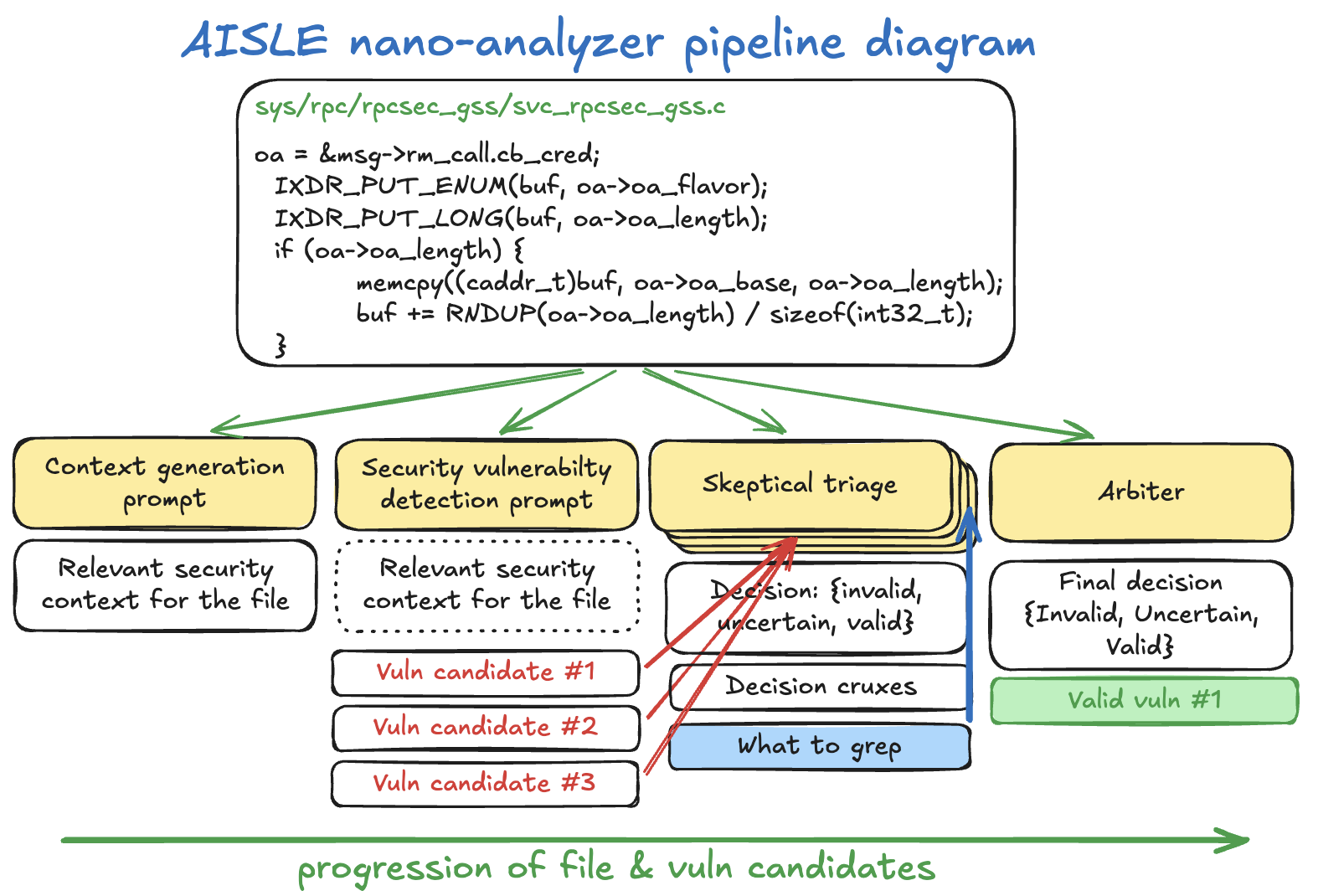
BudgetScan builds upon the open-source scanner nano-analyzer by AISLE (Apache-2.0, introduced on their blog). Here is the original architecture, and how we are extending it with budget and deadline governance.

nano-analyzer pipeline architecture schema by AISLE

Original nano-analyzer schema (by AISLE): Source repository decomposition → context & scan → multi-round triage filter → markdown report.

What We Are Building On Top of the Original Core

💰 Pre-Scan Cost Estimator (`budget.py`)

Measures scannable source files, estimates prompt and output tokens for context, scan, and triage stages, and projects costs before executing.

⚖️ Runtime Budget Governor (`--budget-usd`)

Reserves an upper bound before each LLM call, earmarks triage budget for admitted files, and settles actual token spend afterwards.

⏱️ Deadline Cap Enforcement (`--deadline`)

Prevents CI pipeline timeouts by tracking elapsed wall-clock time and gracefully posting partial reports listing the files covered.

🔍 Multi-Round Skeptical Triage (Rounds 1–5)

Findings of medium severity and above undergo multi-round skeptical cross-examination with code search (`rg`) and an arbiter pass.

⚡ Skip Unchanged Files (Roadmap)

Skipping unchanged files across commits so you don’t pay twice to audit identical code exists today in a community Go port and is planned for the main scanner.

🛡️ GitLab MR & GitHub Actions Integration

CI integrations that scan changed files on merge/pull requests and keep a single report comment up to date (in private testing; see the how-to).

Run from the CLI or Your CI Pipeline

Runs anywhere Python and Git run. See the How-To Guide for full setup details and current status.

# Clone the public open-source scanner:
git clone https://github.com/Huge/nano-analyzer.git
cd nano-analyzer

# Run a scan with 3 skeptical triage rounds:
export OPENROUTER_API_KEY=sk-or-...
python3 scan.py /path/to/src --model qwen/qwen3-32b --triage-rounds 3
# .gitlab-ci.yml (early-access MR integration in private testing):
include:
  - local: gitlab/.gitlab-ci.yml

variables:
  NANO_GITLAB_IMAGE: registry.gitlab.com/<group>/<project>/nano-analyzer:latest
  NANO_GITLAB_SCAN_MODE: changed
  NANO_GITLAB_TRIAGE_ROUNDS: "3"
# .github/workflows/nano-analyzer.yml: scan changed files on pull_request
name: nano-analyzer
on: pull_request
permissions:
  contents: read
jobs:
  scan:
    runs-on: ubuntu-latest
    steps:
      - uses: actions/checkout@v4
        with: { fetch-depth: 0 }
      - uses: actions/checkout@v4
        with: { repository: Huge/nano-analyzer, path: .nano-analyzer }
      - name: Scan changed source files
        env:
          OPENROUTER_API_KEY: ${{ secrets.OPENROUTER_API_KEY }}
        run: |
          git diff --name-only --diff-filter=AMRT "origin/${{ github.base_ref }}...HEAD" \
            | grep -E '\.(c|h|cc|cpp|go|py|js|ts|rs|java)$' > changed.txt || true
          [ -s changed.txt ] || exit 0
          xargs -a changed.txt python3 .nano-analyzer/scan.py \
            --model qwen/qwen3-32b --repo-dir . --output-dir scan-results

Why Pay Per Scan Instead of Per Seat

No idle seats. You pay for the scans that actually run.

Budget Control

Credit Deducted Only on Execution

No seat licenses for developers who rarely open a PR. Credits are deducted only when a scan runs, based on what it actually cost. Failures are rare, and when one happens, nothing is charged.

Accuracy

Multi-Round Skeptical Triage

AI scanners produce noise when unchecked. Findings of medium severity and above go through skeptical review rounds to filter out false positives. Treat results as strong leads for a human reviewer, not verdicts.

Deadline-Aware

Deadline-Aware Scans

With --max-delay 5m, BudgetScan is designed not to hold up CI pipelines: when the deadline approaches, it stops starting new work and posts a partial report listing what was covered.

Multi-Round Triage Attrition

BudgetScan subjects suspected findings to sequential rounds of skeptical review before reporting them to a human reviewer:

Stage 1–2
Context & Initial Scan
Round 1
Skeptical Code Check
Rounds 2–5
Cross-File Search (rg)
Arbiter
Split-Vote Resolution
Survivors
Actionable Leads for Humans

Success Stories: Proven Upstream Track Record

Real results on real open-source projects, with links you can verify. Findings are leads for maintainers, checked by a person before we report them.

Fixed in OpenBSD CVS • Oct 2026

tmux: server crash on copy-mode -S

Dereferencing a NULL client pointer in copy-mode -S crashed the tmux server and all sessions. Lead maintainer Nicholas Marriott accepted our report and committed the fix to OpenBSD.

“Applied to OpenBSD now, will be in GitHub later. Thanks!” — Nicholas Marriott

How to read this. The scanner flagged the unguarded pointer as a lead; an engineer isolated the hook trigger, wrote the regression test, and reported the fix.

Released in v1.36.0 • Oct 2026

KDE Connect: unbounded Bluetooth buffer

Android Bluetooth backend buffered incoming packets with no size limit, allowing memory exhaustion from a paired device. Creator and maintainer Albert Vaca Cintora merged our fix in MR !696.

“Thanks for catching this!” — Albert Vaca Cintora

How to read this. Triage called the attacker remote; reading the code narrowed it to an opt-in beta backend and an already paired device.

Merged upstream • Oct 2026

Himalaya: terminal escape & BiDi spoofing

Unescaped metadata in terminal tables allowed OSC 52 clipboard overrides. Maintainer Clément Douin extracted our sanitization into shared pimalaya-cli 0.2.6 with co-authorship credit.

“Thanks for the report and the clear write-up, the problem is real.” — Clément Douin

How to read this. Collaboration with the maintainer turned a single bug report into a shared function for sister CLI tools.
Browse All 11 Open-Source Case Studies & Benchmarks →

Where Does My Code Go?

Short answer: only to the LLM provider you choose. For hosted scans that is EU inference with zero data retention; self-hosted against your own endpoint, nowhere outside your infrastructure.

Zero Data Retention by Default

Hosted BudgetScan scans run on inference from our partner Kosmik Compute, which operates with zero data retention: prompts and outputs are not stored and are never used to train models. Only operational metadata (such as request logs) is kept, for up to 30 days. Their privacy details.

Hosted in the EU

Kosmik’s servers are in Prague and the operator is a Czech company under GDPR. The inference API is OpenAI-compatible: see the API docs.

Or Keep It On-Prem

The scanner is open source (Apache-2.0) and runs on your own infrastructure. Pointing it at your own LLM endpoint (vLLM, Ollama or any OpenAI-compatible server), so your code never leaves your network, works in our early-access build and is coming to the open-source scanner, which today calls OpenAI or OpenRouter.

Simple Pay-Per-Scan Credit Pricing

No recurring subscriptions or per-developer seat fees. Top up a credit pack for your team, set budget caps per pull request, and pay only for completed audits. Failed scans are never charged.

View Credit Packs & Savings Calculator Privacy & Operator Details